
On June 5, KAUST joins the global community in marking World Environment Day, led by the United Nations Environment Programme (UNEP). This year’s theme focuses on climate action, emphasizing the need to move from awareness to practical, measurable steps that reduce environmental impact. At KAUST, this message connects directly to ongoing work to understand the University’s greenhouse gas (GHG) emissions and use that knowledge to shape a Climate Action Plan.
As a research university, residential community, and city-scale campus, KAUST operates a complex system of laboratories, housing, schools, utilities, cooling infrastructure, water treatment, transport, waste services, and community facilities. This makes our emissions profile more similar to a small city than a traditional university campus.
To support evidence-based decision-making, KAUST has developed a comprehensive GHG emissions inventory aligned with the GHG Protocol. This inventory is a collaborative effort involving multiple operational teams to measure Scope 1, Scope 2, and Scope 3 emissions, providing a comprehensive snapshot of the University’s climate impact.
Scope 1 includes direct emissions from sources owned or controlled by KAUST, such as fuel combustion in campus operations and fleet activities. Scope 2 covers indirect emissions from purchased electricity, which supports KAUST’s laboratories, offices, housing, utilities, and community infrastructure. Scope 3 captures wider value chain emissions, including areas such as procurement, travel, waste, construction, leased assets, and other activities connected to the University’s operations.
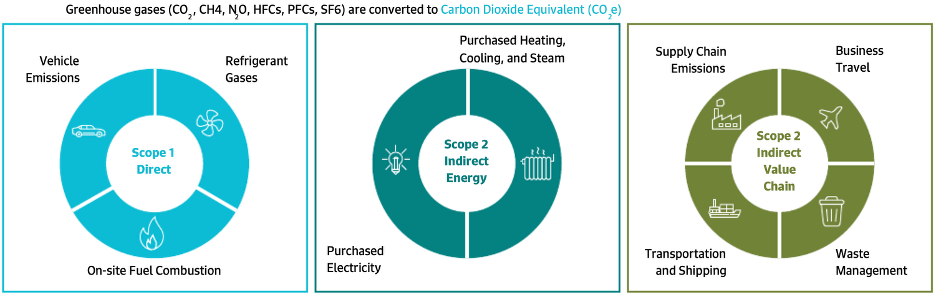
GHG Protocol Scopes for Organizational Carbon Accounting: This work is a critical foundation for KAUST’s upcoming Climate Action Plan. By measuring emissions across all three scopes consistently, identifying the largest sources, and understanding the differences between academic campus operations and the wider residential community, KAUST can define data-driven targeted, practical, and scalable interventions.
The inventory has already helped highlight key areas for action, including electricity consumption, cooling efficiency, infrastructure upgrades, procurement practices linked to supply chains, travel, construction, and leased assets. These insights are helping KAUST move from measurement to action by identifying where operational changes, technology solutions, and community engagement can deliver meaningful reductions.
For this year’s World Environment Day, KAUST recognizes that climate action requires a shared institutional effort. The emissions inventory is not only a reporting tool, but also a decision-making framework that helps to embed sustainability in operations and long-term planning.
As KAUST continues developing its Climate Action Plan, the University is strengthening the data, governance, and collaboration needed to reduce emissions, improve resource efficiency, and contribute to the Kingdom’s broader climate and sustainability goals.
World Environment Day reminds us that meaningful climate action starts with knowing where we stand, and using that knowledge to shape where we go next.