
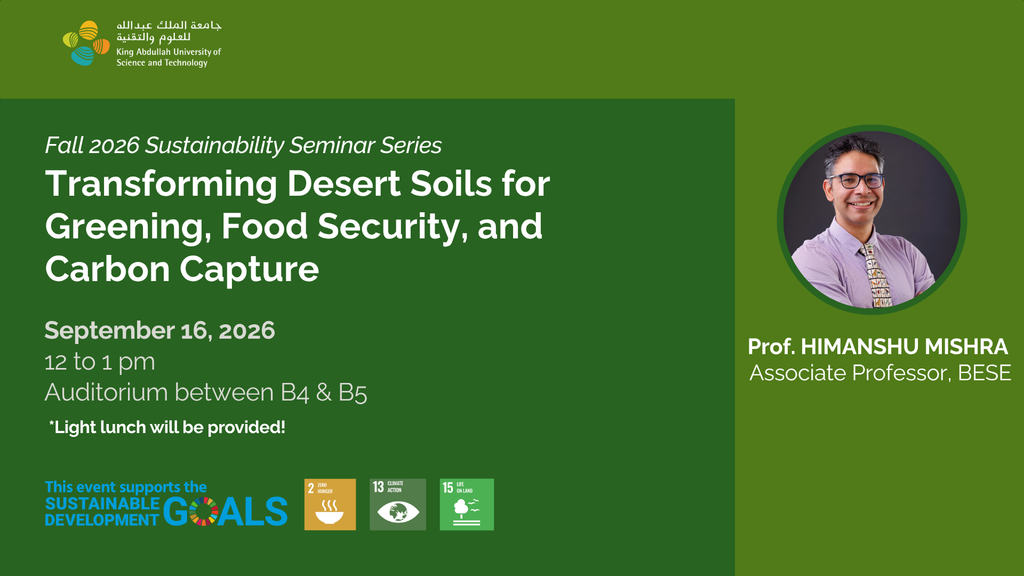
Date: September 16, 2026
Time: 12 :00– 1:00 PM
Location: Auditorium between bldgs 4 & 5
The Office of Sustainability is pleased to announce its Fall 2026 Sustainability Seminar Series, designed to strengthen sustainability literacy and deepen understanding of the United Nations’ Sustainable Development Goals (SDGs), and their connection to the objectives of Saudi Vision 2030. Through timely themes and diverse perspectives, the series explores how research, practice, and society can contribute to environmental protection, social well-being, and economic prosperity. It provides a space for knowledge sharing, dialogue, and meaningful engagement within KAUST and beyond.
In his seminar, Prof. Himanshu Mishra will challenge a commonly held assumption: that growing plants necessarily leads to net carbon capture. This question is crucial as Saudi Arabia and several other Gulf nations have pledged to plant billions of trees to offset their carbon footprint and realize broader ecosystem benefits. However, growing plants in sandy, alkaline soils is a daunting endeavor: these soils struggle to retain water and nutrients, while alkalinity limits the availability of key nutrients.
The seminar presents his group’s research on Carbosoil™, a KAUST-developed engineered biochar, to address these challenges. By converting organic waste, such as date palm residues and animal manure that would otherwise be landfilled or burned, into a soil amendment, this approach explores how desert soils can support plant growth and long-term carbon storage.
The material acts as a sponge for nutrients and resists breakdown, allowing it to persist in soils over long periods. Field trials with industrial partners in Saudi Arabia have shown enhanced growth of native plants in treated sandy soils. However, plant growth alone does not tell the full story: carbon accounting has revealed that emissions from irrigation and fertilization can outweigh the carbon captured by plants in untreated soils. The findings show how the amendment’s long-term carbon storage, combined with enhanced plant growth, can shift this balance toward net carbon capture.
Prof. Mishra will present these findings alongside comparisons with common soil amendments, including peat moss and compost, examining their implications for resource-use efficiency, carbon capture, and economics. Drawing on multiyear field trials, he will also explore what these insights mean for desert agriculture, and what it takes for greening efforts to deliver lasting environmental benefits.
Together, these results chart a science-based, field-tested path toward the United Nations’ Sustainable Development Goals of Zero Hunger (SDG 2), Climate Action (SDG 13), and Life on Land (SDG 15).
Prof. Mishra’s research on desert soils, food security, and carbon capture have been featured by CNN. Watch the feature here.

2 comments
Thank you for this valuable work. It is particularly noteworthy because it goes beyond the common assumption that tree planting necessarily results in net carbon sequestration and instead assesses the complete carbon balance. I would appreciate your insights on the following questions: Based on the trials, which management factor had the greatest influence on achieving net-negative emissions – biochar application, improved irrigation efficiency, or optimized nutrient management? In the context of Saudi Arabia’s large-scale greening initiatives, what are the principal technical and economic barriers to scaling Carbosoil™ production from organic waste streams, and how does its cost–benefit profile compare with that of conventional soil amendments such as peat moss and compost? Finally, beyond carbon sequestration and plant growth, have you observed measurable changes in soil microbial communities, nutrient-use efficiency, or water-use efficiency that could support the long-term sustainability of desert agricultural systems?
Dear Abdullah,
Thank you for raising some interesting questions.
We suggest that you join us at the seminar and directly ask these to Prof. Mishra to evoke some thought-provoking discussions which will be beneficial for the attendees as well.
Warm regards,
Office of Sustainability
Comments are closed.