
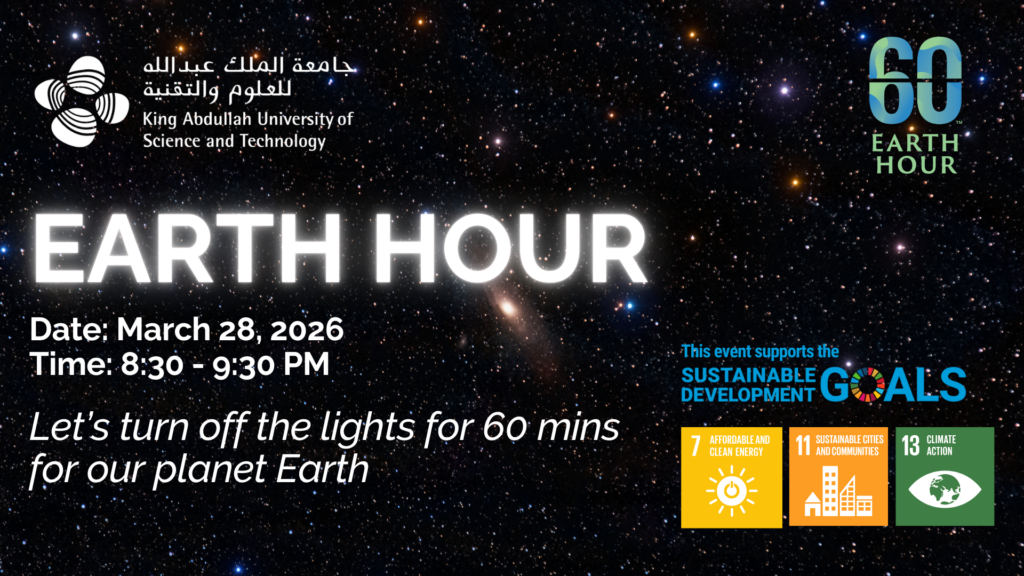
Earth Hour represents a shared commitment to addressing climate change, protecting our natural environment, and pursuing a resource-efficient future. Earth Hour is more than a symbolic gesture; it is a collective moment to reflect on our environmental impact and the actions we can take, both individually and as a community, to support a more sustainable future.
Date: Saturday, March 28, 2026
Time: 8:30 – 9:30 p.m.
Where: Campus Spine, King Abdullah Monument, Harbor Walkway, Beacon, and Amphitheater
At KAUST, we recognize that our operations are inherently energy-intensive, with laboratories and critical infrastructure running continuously. In this context, Earth Hour is less about immediate energy reduction and more about promoting a shared culture of sustainability and responsible resource use across our community.
As part of KAUST’s ongoing commitment to sustainability and environmental stewardship, the University will participate in Earth Hour 2026 by turning off the lights across key campus and community locations, including the Campus Spine, King Abdullah Monument, Harbor Walkway, Beacon, and Amphitheater.
We invite all members of the KAUST community to join this global initiative by switching off the lights in your homes for one hour.
Extending impact beyond the hour
While Earth Hour lasts 60 minutes, its message extends far beyond.
Long-term impact comes from large-scale solutions, but everyday actions across our community remain an important part of reducing energy use and emissions. C&C encourages the community to adopt the following simple, energy-efficient practices:
Your contribution at KAUST
- Adjust your thermostat: Set air conditioning to 23°C for optimal comfort and efficiency
- Maximize natural light: Reduce reliance on artificial lighting during the day
- Unplug idle electronics: Prevent unnecessary energy use from devices on standby
- Switch to LED lighting: Improve efficiency and reduce long-term energy consumption
- Choose sustainable transport: Walk, take the bus, or carpool where possible
- Practice reduce, reuse, recycle: Minimize waste and conserve resources
Small actions, when adopted consistently across a campus of this scale, contribute to meaningful change.
For further information, please contact the Campus & Community team or the Office of Sustainability.