
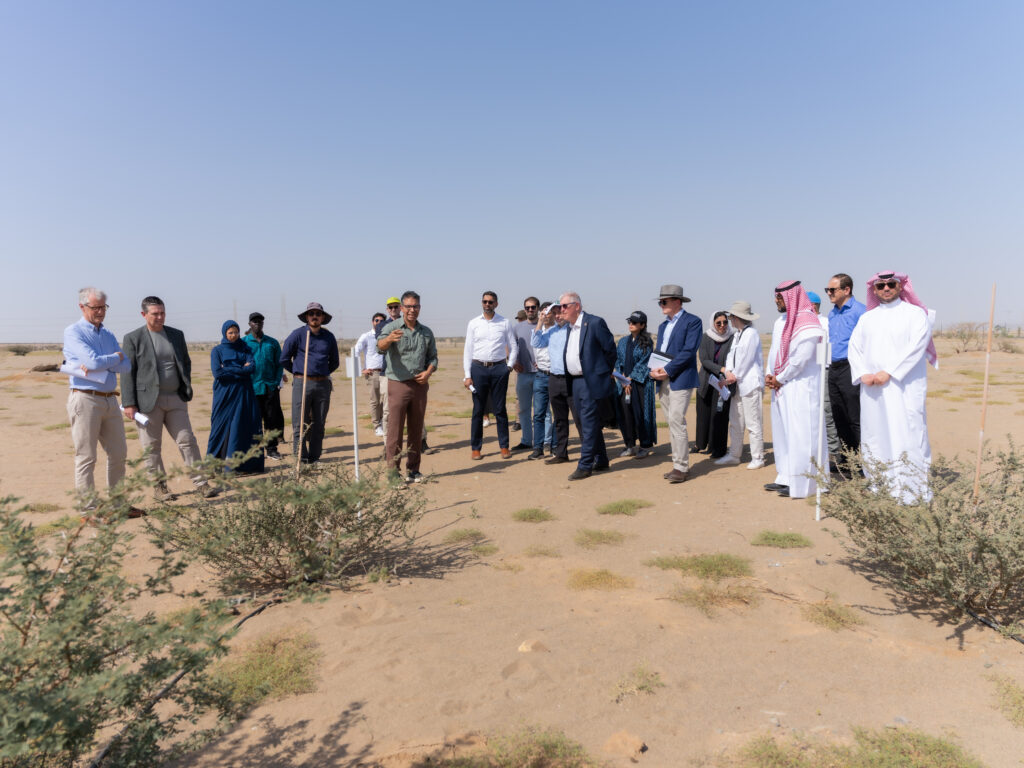
Senior leadership from KAUST visited the Wadi Qudaid Experiment Station on 29 January to see first-hand the impact of the University’s investment in translational research and technology deployment for sustainable food security and environmental resilience. The delegation included President Sir Edward Byrne, Deputy Vice President for Research Professor Samir Hamdan, Executive Director of Missions Dr. Martin Kirk, Chief Financial Officer Dr. Richard Sobieray, and Chief of Staff Dr. Andrew MacLeod, alongside colleagues from research, operations and communications.
The visit, led by Dr. Rebekah Waller, Station Director, and Professor Mark Tester, Chair of the Center of Excellence for Sustainable Food Security, enabled senior leaders to engage directly with the work underway at the station, which has been developed over the past two years in collaboration with the National Center for Vegetation Cover Development and Combating Desertification (NCVC). Located in Wadi Qudaid National Park in the Makkah Region, the facility is a key example of KAUST translating research and innovations beyond campus and into national impact.
During the visit, the delegation was briefed on the current infrastructure and research activities at the station, including presentations from five KAUST research teams and spin-out companies operating pilot projects on-site. General Manager of NCVC Makkah Region Mr. Adel Altayyari toured the delegation through the Center’s new operations building, located adjacent to the station. Discussions focused on how the station is being used to test interventions for vegetation restoration and desert afforestation, support research on native plant species and genetics, and enable translational science aligned with the Saudi Green Initiative and national development goals in food, energy, and water sectors.
Professor Mark Tester emphasized the strategic importance of the site, saying: “The Wadi Qudaid Experiment Station is a clear example of how KAUST investments translate into real impact. By taking our science beyond the campus walls and working closely with national partners, we are helping deliver solutions that support the Kingdom’s ambitions in sustainable food security and environmental restoration.”
The delegation also discussed the station’s role in strengthening collaboration with NCVC and other national stakeholders, supporting revegetation programs, and providing a long-term platform for field-based research beyond the KAUST campus, reinforcing the University’s commitment to practical, on-the-ground outcomes for the Kingdom and beyond.