
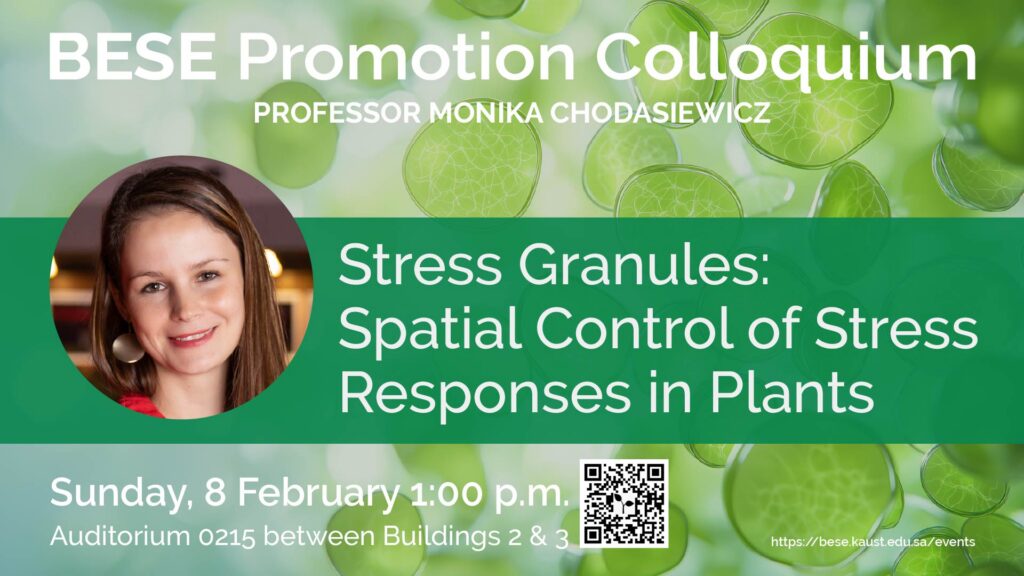
Date: Sunday, February 8, 2026
Time: 1:00 p.m. – 2:30 p.m.
Location: Auditorium 0215 between Buildings 2 and 3 and Zoom
As part of the University’s current promotion cycle, Assistant Professor Monika Chodasiewicz is being considered for promotion to Associate Professor of Plant Science. A requirement of this process is the delivery of a technical colloquium. This presentation will highlight Prof. Chodasiewicz’s research interests and scientific achievements.
TITLE: Stress Granules: Spatial control of stress responses in plants
Abstract
Biomolecular condensates have emerged as a transformative paradigm in cell biology, redefining how cells organize biochemical reactions in the absence of membranes. Among them, stress granules (SGs) are highly dynamic assemblies formed through liquid–liquid phase separation that transiently compartmentalize proteins, RNA, and metabolites to regulate signaling, translation, and metabolism during stress. While SG biology is well established in mammalian systems—where defects in their dynamics are linked to neurodegenerative diseases—their existence and function in plants long remained unexplored. Addressing this gap became a defining focus of my research, motivated by the hypothesis that SGs represent a previously hidden but powerful regulatory layer in plant stress adaptation.
In this talk, I will present how our work has helped establish plant SG biology as a new research field and reveal their central role in stress tolerance. Using genetic, biochemical, and multi-omics approaches, we demonstrated that SGs actively regulate translational control by sequestering ribosomal subunits and that perturbing key SG components can enhance thermotolerance, photosynthetic recovery, and hormonal balance. Beyond the cytosol, we uncovered stress-induced condensates in chloroplasts, revealing that condensation safeguards essential metabolic processes across cellular compartments.
I will further discuss our efforts to decode SG dynamics and recruitment mechanisms using time-resolved proximity labeling, live imaging, and RNA-focused approaches. These studies reveal that SGs assemble within minutes of stress, recruit proteins in a temporally ordered manner, and selectively sequester modified transcripts, pointing to an emerging epitranscriptomic code governing condensate function. Expanding beyond proteins and RNA, we are defining the contribution of metabolites and developing AI-assisted high-throughput platforms to chemically modulate SG dynamics.
Finally, I will outline our future vision: translating SG biology from Arabidopsis to crops and wild species to enhance stress resilience, and leveraging conserved condensate mechanisms for broader applications. Together, these discoveries position biomolecular condensates as a central organizing principle of plant stress signaling and a promising target for next-generation strategies in sustainable agriculture and food security.
Bio
Dr. Monika Chodasiewicz is an Assistant Professor in the Plant Science program within the Biological and Environmental Science & Engineering (BESE) Division at King Abdullah University of Science and Technology (KAUST) and an Executive Member of the Center of Excellence for Sustainable Food Security (CoE-SFS). She earned her Ph.D. in Plant Molecular Physiology (2010–2014), during which she contributed to the discovery of the oxygen-sensing mechanism in plants. The team’s work was recognized by Sir Peter J. Ratcliffe in his 2019 Nobel lecture on the discovery of the low-oxygen-sensing mechanism in human cells. Prior to joining KAUST, she completed her postdoctoral training in Biochemistry (2014–2020) at the Max Planck Institute of Molecular Plant Physiology in Germany, where she developed innovative methods for studying small-molecule–protein interactions. Since November 2020, Dr. Chodasiewicz has been leading a research group at KAUST dedicated to identifying and functionally analyzing stress-specific components—proteins, metabolites, and mRNAs—associated with stress granules (SGs) formed under challenging environmental conditions. Her pioneering work on biomolecular condensates in plants has established a new research direction in plant biology, catalyzing the growth of a broader scientific community investigating condensate-mediated stress responses.